How to Practice Speaking Spanish When You Have No One to Talk To
You can read Spanish, you've done the app streaks, you understand more than you can say — and then a real conversation starts and your mind goes blank. That gap between *understanding* and *speaking* is the most common wall in language learning, and the usual advice ("just talk to natives!") is useless when you don't have a partner, the time zones don't line up, or the idea of fumbling in front of a stranger makes you want to close the tab.
The good news: speaking is a skill you can train alone, and several of the most effective techniques need nothing but your own voice and a few minutes a day. Here's what actually works, why, and how to put it into a simple routine.
Why speaking feels so much harder than reading
It isn't your imagination. In second-language research, speaking is consistently identified as the most anxiety-provoking skill — the foundational work on Foreign Language Classroom Anxiety (Horwitz, Horwitz & Cope, 1986) found that oral production triggers the most apprehension, and later meta-analysis found language anxiety correlates negatively with achievement (a moderate correlation of about −0.36). In plain terms: nerves don't just feel bad, they measurably hold your speaking back.
Two things drive the gap:
- Retrieval under pressure. Recognising a word when you read it is far easier than pulling it out of memory and saying it in real time.
- No reps. Most study is silent — reading, tapping, listening. You can't get fluent at a thing you rarely actually *do*. Speaking improves when you speak.
So the fix isn't more vocabulary. It's more reps, out loud, with less fear. Here's how to get them solo.
6 ways to practice speaking Spanish with no partner
1. Narrate your day (self-talk)
Describe what you're doing, out loud, in Spanish: *"Estoy haciendo café, hace frío hoy, tengo una reunión a las diez."* It feels silly, but talking to yourself — "private speech" in the research — is a documented tool for rehearsal and self-regulation in language learning. It builds the retrieval muscle with zero social pressure. When you hit a word you don't know, that's your vocabulary list for the day.
2. Shadowing
Play a short clip of a native speaker and talk *over* it, a beat behind, copying their rhythm, stress and intonation. Shadowing has classroom evidence for improving listening and pronunciation (Hamada, 2016), and it trains your mouth to produce natural Spanish sound patterns instead of English ones. Start with slow, clear audio; don't worry about understanding every word at first.
3. Think in Spanish
Run your inner monologue in Spanish for a few minutes at a time — planning, reacting, commenting to yourself. This is inner speech, the same private-speech mechanism as self-talk, and it makes Spanish your *default* for simple thoughts so you don't have to translate from English mid-sentence.
4. Practise retrieval, not recognition (spaced repetition)
Flashcards and apps are only useful if they make you *produce* the word, not just recognise it — and if they bring it back on a spacing schedule. Distributed practice is one of the most robust findings in learning science (Cepeda et al., 2006, reviewing 317 experiments): spacing reviews out beats cramming. Practising recall out loud — say the word/sentence, don't just read it — turns a passive word list into speakable vocabulary.
5. Use comprehensible input *and* output
Krashen's input hypothesis says you acquire language from input slightly above your level ("i+1"). But input alone makes a great listener, not a great speaker — Swain's output hypothesis adds that *producing* language forces you to notice the gaps in what you can actually say. Translation for solo practice: consume Spanish you mostly understand (podcasts, shows), then say something back — summarise the episode aloud, answer the host's questions.
6. Talk to an AI (the modern shortcut to daily reps)
The biggest reason solo practice fails isn't technique — it's that talking to yourself gets lonely and there's no feedback, so you stop. This is where an AI conversation partner has become genuinely useful: it gives you an unscripted conversation on demand, corrects you in the moment, and never judges you for repeating the same broken sentence five times. It removes the two things that kill solo practice — no partner, and no feedback.
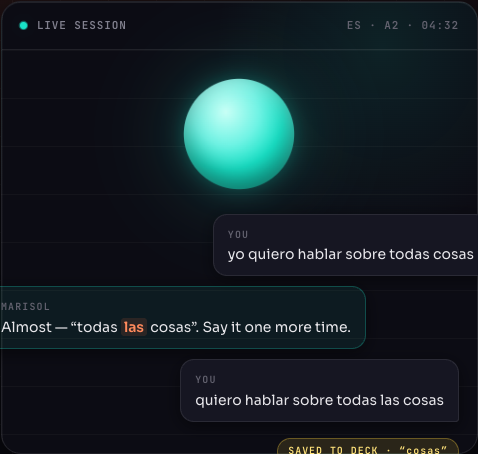
That's exactly what we built Langusta for: you have a real spoken conversation at your level, it corrects you as you go, and it remembers the words you fumbled so they come back in later sessions. It's the judgment-free way to get the daily reps in before you ever sit across from a person. There's a free 10-minute trial if you want to feel it: talk to it now.
A simple 15-minute daily routine
You don't need an hour. Consistency beats intensity:
- 5 min — shadowing: one short native clip, repeat over it.
- 5 min — output: narrate your day, or summarise something you watched, out loud.
- 5 min — a real conversation: with an AI partner (or a tutor/exchange partner when you have one), pushing yourself to say slightly more than you're comfortable with.
End each session by saving 2–3 words you reached for and didn't have. Review them, out loud, the next day.
Frequently asked questions
Can you really learn to speak a language without a partner?
You can build the underlying skill — retrieval, pronunciation, fluency of common phrases — entirely solo, and it makes real conversations far less scary. You'll still want real conversations eventually (with people or an AI partner) to handle the unpredictability of live dialogue, but the solo work is what makes those count.
How long until I can hold a basic conversation?
It depends on your starting point and how often you practise, but daily *speaking* reps move the needle far faster than the same time spent reading or tapping. The single biggest predictor is frequency — a few minutes every day beats one long session a week.
Is talking to myself in Spanish actually effective?
Yes — it's backed by research on private speech in language learning, and it's the lowest-friction way to practise retrieval. The point isn't perfection; it's getting Spanish out of your head and into your mouth, often.
What's the best way to get speaking feedback alone?
A human tutor gives the richest feedback but costs money per hour and needs scheduling. An AI conversation tool gives instant, judgment-free correction on demand — a good fit for daily practice between (or instead of) tutor sessions.
*Sources: Horwitz, Horwitz & Cope (1986), "Foreign Language Classroom Anxiety," The Modern Language Journal; meta-analytic correlation between language anxiety and achievement (≈ −0.36); Hamada (2016) on shadowing, Language Teaching Research; Cepeda, Pashler et al. (2006), "Distributed Practice in Verbal Recall Tasks," Psychological Bulletin; Krashen (1982), Principles and Practice in Second Language Acquisition; Swain (1995), output hypothesis. Methods are well-established in second-language research; individual results vary.*
Try Langusta free
An AI voice tutor for English speakers learning Spanish — unscripted conversation, live corrections, and spaced-repetition on the words you fumble. No card needed.
▶ Talk to it now