Does Duolingo Actually Teach You to Speak Spanish? (And What Max Adds)
Duolingo is how a huge number of people start a language — Spanish is the #2 most-studied language on the platform (English is #1), per Duolingo's own 2025 Language Report. It's free, it's genuinely good at some things, and the streak keeps you coming back. But a question comes up again and again from people who've kept a long streak: *"Why can I still barely speak?"*
Here's an honest look at what Duolingo does well, where it falls short for speaking, what Duolingo Max changes, and how to close the gap.
What Duolingo is genuinely good at
Credit where it's due:
- Habit and consistency. The streak mechanic gets you practising daily, which matters more than any single feature.
- Vocabulary and recognition. You build a big passive vocabulary and get comfortable reading and understanding.
- Zero friction and free. No scheduling, no cost to start, bite-sized lessons.
For absolute beginners building a foundation, that's real value.
Where it falls short for speaking
The core Duolingo lesson is tap-based: choose the right word, arrange the tiles, fill the blank, occasionally repeat a sentence the app shows you. That trains recognition — seeing the right answer and confirming it. Speaking is the opposite skill: retrieval and production — pulling words out of your own head and saying them in real time, with no tiles to choose from.
That's why long-streak learners hit the wall: tapping the correct answer is not the same as *saying* it to a person who's looking at you. The two things real speaking requires — producing language unprompted, and doing it under the mild pressure of a live exchange — aren't what the standard lesson drills.
What Duolingo Max adds
Duolingo's premium tier, Max, adds AI-powered speaking features — most notably Video Call (a conversation with the AI character "Lily") and Roleplay scenarios. These are a real step up: you actually speak, and you get AI responses and feedback.
Two honest caveats:
- They're paid. Video Call and Roleplay are Duolingo Max features (Duolingo's own investor announcements describe them as part of Max). If you're on the free tier, the open-conversation practice isn't included.
- They're scenario-guided. Roleplay runs through set scenarios, and the conversations are steered rather than fully open-ended. That's great for structured practice, but it's not the same as "talk about literally anything, follow the tangents, get corrected on what *you* chose to say."
What's still missing for real speaking
Even with Max, three things tend to be missing for someone whose specific goal is *fluent, confident conversation*:
- Unscripted conversation. Real talk wanders. The more a session is on rails, the less it rehearses the unpredictability you'll actually face.
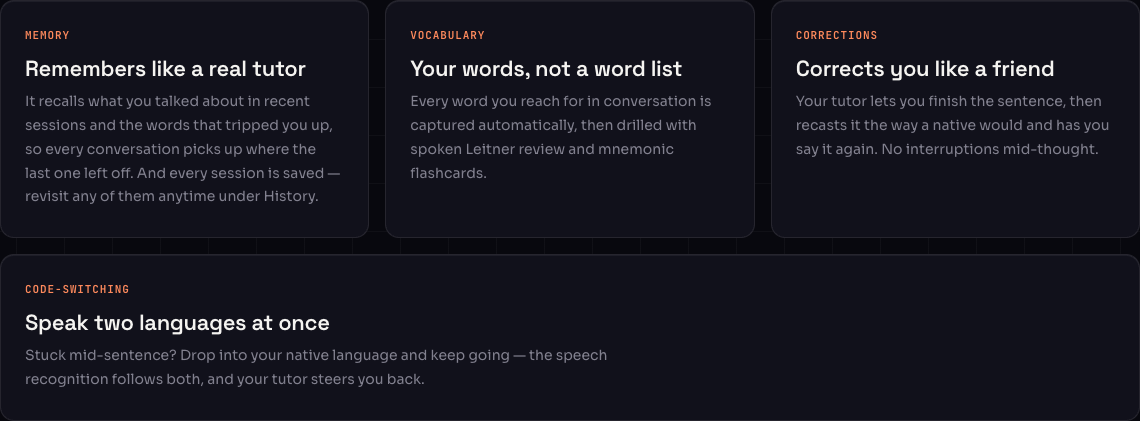
- Correction of your spontaneous output. Being corrected on a scripted prompt is useful; being corrected on the sentence you improvised — the one you'd actually say — is where the learning sticks.
- Memory across sessions. Most apps start each session from scratch. A real tutor remembers what you struggled with last time and brings it back.
How to close the gap
You don't have to abandon Duolingo — pair it with something that trains the part it doesn't:
| Goal | Best fit |
|---|---|
| Vocabulary, habit, beginner foundation | Duolingo (free) |
| Guided AI speaking practice inside Duolingo | Duolingo Max |
| Open, unscripted conversation + correction on demand | An AI conversation app (e.g. Langusta) |
| Real human conversation, accountability, exam prep | A human tutor (italki, Preply) |
If your blocker is specifically *speaking* — getting the words out, unprompted, without freezing — the highest-leverage addition is daily unscripted conversation practice with feedback. That's what we built Langusta to do: you have a real spoken conversation at your level, it corrects you as you go, and it remembers the words you fumble and resurfaces them in later sessions, so it continues like a real tutor instead of resetting. There's a free 10-minute trial: try a conversation.
Frequently asked questions
Can you become fluent with Duolingo alone?
You can build a strong foundation — vocabulary, reading, listening, and a daily habit. But fluency in *speaking* needs production practice (talking, getting corrected, handling unscripted exchanges) that the core tap-based lessons don't provide. Most people who get to conversational fluency pair Duolingo with actual speaking practice.
Is Duolingo Max worth it for speaking?
If you want to speak and you're staying within Duolingo, Max's Video Call and Roleplay are a clear upgrade over the free tap-lessons. Just know the practice is scenario-guided rather than fully open-ended, and it's a paid tier.
What's the fastest way to actually start speaking Spanish?
Daily reps of speaking out loud, with feedback, even just a few minutes. Whether that's a tutor, a language partner, or an AI conversation app, the key is producing the language frequently — not just recognising it.
*Sources: Duolingo 2025 Language Report (Spanish = #2 most-studied language overall; published December 2025); Duolingo investor/product announcements describing Video Call and Roleplay as Duolingo Max features. Feature availability and pricing change — check Duolingo's current plans. We did not confirm any claim that Video Call is free; treat open-conversation features as part of paid Max unless Duolingo states otherwise.*
Try Langusta free
An AI voice tutor for English speakers learning Spanish — unscripted conversation, live corrections, and spaced-repetition on the words you fumble. No card needed.
▶ Talk to it now