The Best Ways to Practice Speaking Spanish in 2026 (Tutors, Apps & AI Compared)
Spanish is one of the most-learned languages in the world — around 24.6 million people study it as a foreign language (Instituto Cervantes, 2025) — and almost all of them hit the same wall: understanding comes long before speaking. If your goal is specifically to *talk*, the tool you pick matters, because the options train very different things.
Here's an honest comparison of the four main ways to practise speaking Spanish in 2026, what each is best for, and how to choose.
The four categories (and what each is actually good at)
1. Human tutors — italki, Preply.
Real conversation with a real person. Best for accountability, cultural nuance, and rich feedback. The trade-offs: you book and schedule sessions, you pay per hour, and quality varies by tutor. italki is a marketplace where tutors set their own rates — for Spanish, italki's own guidance puts community tutors roughly in the $8–25/hour range and professional teachers higher. Great for a weekly reality check; expensive and high-friction for *daily* practice.
2. AI conversation apps — Langusta, Speak, Talkpal.
You talk out loud to an AI that responds and corrects you, on demand, 24/7, with no scheduling and no judgment. Best for getting *frequent* speaking reps cheaply. They vary a lot: some are curriculum-driven (more lesson-on-rails), others are open conversation. This category has grown fastest because it solves the "I just need to talk, right now, without booking anyone" problem.
3. Tap-based courses — Duolingo, Babbel, Busuu.
Excellent for vocabulary, reading, and building a daily habit. The core lessons are mostly multiple-choice and repeat-after-me, so they train recognition more than spontaneous speaking. Some now bolt on AI speaking features (e.g. Duolingo Max's Video Call/Roleplay), usually on a paid tier and scenario-guided.
4. Audio courses — Pimsleur.
Strong for pronunciation and listening through structured "listen and repeat" drills. It's prompted recall, though — not a responsive, unscripted partner that reacts to what you say.
Compare by what matters for speaking
The price is less important than whether a tool actually trains *speaking*. Here's how the categories stack up on the things that build fluency:
| On demand (no scheduling) | Unscripted conversation | Corrects your own speech | Remembers past sessions | Cost model | |
|---|---|---|---|---|---|
| Human tutor (italki/Preply) | No (book ahead) | Yes | Yes (human) | Depends on the tutor | Pay per hour |
| AI conversation (Langusta) | Yes | Yes | Yes | Yes | Flat monthly |
| Tap-based (Duolingo/Babbel) | Yes | Limited (paid/guided) | Mostly scripted prompts | No | Free + paid tier |
| Audio (Pimsleur) | Yes | No (repeat-after-me) | No (no recognition of your output) | No | Subscription |
(Prices and features change and vary by region/promotion — check each provider's current plans before buying. We only quote figures we can attribute.)
Which should you pick?
- You freeze when you have to speak, and need daily low-pressure reps → an AI conversation app. The judgment-free, anytime practice is exactly what builds the confidence to speak with people.
- You want a real human, accountability, or exam prep (DELE/SIELE) → a tutor on italki or Preply. Worth the per-hour cost for those goals.
- You're an absolute beginner building vocabulary and a habit → start with a tap-based app, then add speaking practice once you've got a base.
- You mainly want better pronunciation on the commute → an audio course like Pimsleur.
A lot of people end up combining them: a tap app for vocab, an AI partner for daily speaking, and a human tutor occasionally for the reality check.
Where Langusta fits
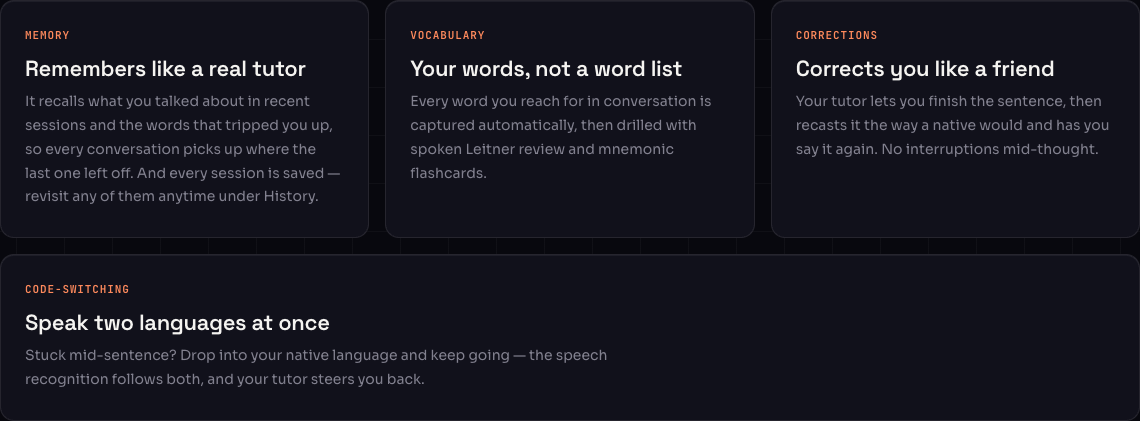
Full disclosure — we build one of these. Langusta is an AI voice tutor built specifically for the "I can read it but I freeze speaking it" problem: unscripted conversation at your level, live corrections, and it remembers the words you fumbled and what you talked about, so each session continues like a real tutor instead of starting over. Plans run monthly (currently $14.99 for 150 voice minutes, $29.99 for 350, $49.99 for 650), and there's a free 10-minute trial with no card: try a conversation.
We think the honest pitch is simple: it's the cheapest, lowest-friction way to get *daily* speaking reps — and a fraction of what daily human tutoring would cost — but a human tutor is still worth it now and then for the things only a person can give you.
Frequently asked questions
What's the best app to practice speaking Spanish?
It depends on your goal. For frequent, low-pressure speaking reps, an AI conversation app is hard to beat on convenience and cost. For real human feedback and accountability, a tutor marketplace like italki. Many learners use both.
Is AI good enough to practice real conversation?
For building confidence, fluency of common phrases, and getting instant correction, yes — and it's available 24/7 with no judgment. For deep cultural nuance and genuine human connection, a person still wins. The pragmatic answer is to use AI for the daily reps and a human occasionally.
Is an AI app cheaper than a tutor?
For *daily* practice, almost always. A flat monthly subscription you can use every day works out far cheaper per session than booking a tutor by the hour several times a week — which is why AI works well for the high-frequency reps that actually build speaking.
How often should I practise speaking?
Short and daily beats long and occasional. Even 10–15 minutes of actually speaking out loud every day moves you faster than one long weekly session.
*Sources: Instituto Cervantes, "El español en el mundo 2025" (≈24.6 million foreign-language learners of Spanish; presented 28 October 2025). italki Spanish tutor pricing per italki's own published guidance (marketplace; tutors set rates). Other providers' specific prices vary by region and promotion and are not quoted here unless attributable — verify current pricing on each provider's site. Langusta pricing is our own current pricing and is subject to change.*
Try Langusta free
An AI voice tutor for English speakers learning Spanish — unscripted conversation, live corrections, and spaced-repetition on the words you fumble. No card needed.
▶ Talk to it now